Gigabot
Industrial Robotics with phine.lab
The Challenge
The development of advanced 5G applications for industries like manufacturing has traditionally been a slow and expensive process. Innovators are often limited to physical testbeds and campus networks, making rapid, iterative development and automated testing nearly impossible. This contradicts modern software practices and creates a significant barrier to leveraging the full potential of 5G technology.
The Solution
The Gigabot project directly addresses this challenge by implementing a modern, software centric approach powered by phine.lab (formerly V5GL). In a strategic partnership with the TEC Lab at TU Wien’s Institute of Production Engineering and Photonic Technologies (IFT), we are demonstrating how our virtual development environment can dramatically accelerate innovation.
The Use Cases
This project focuses on a demanding industrial use case: An Autonomous Mobile Robot (AMR) designed for complex remote operation. The goal is to enable a "Gigabot" to be controlled by a remote expert to perform non routine tasks like troubleshooting machinery or operating legacy equipment that lacks a digital interface.
The Advanced 5G Aspect
This application requires an extremely reliable, low latency 5G connection that utilizes advanced features like precise 5G positioning and dynamic network policy management. To ensure the network meets requirements during critical tasks, we integrated the CAMARA Quality-on-Demand API. Our 5G ROS Gateway monitors the robot's communication and leverages this API to automatically request the specific quality needed to prioritize the connection when it matters most.

Our Technology in Action
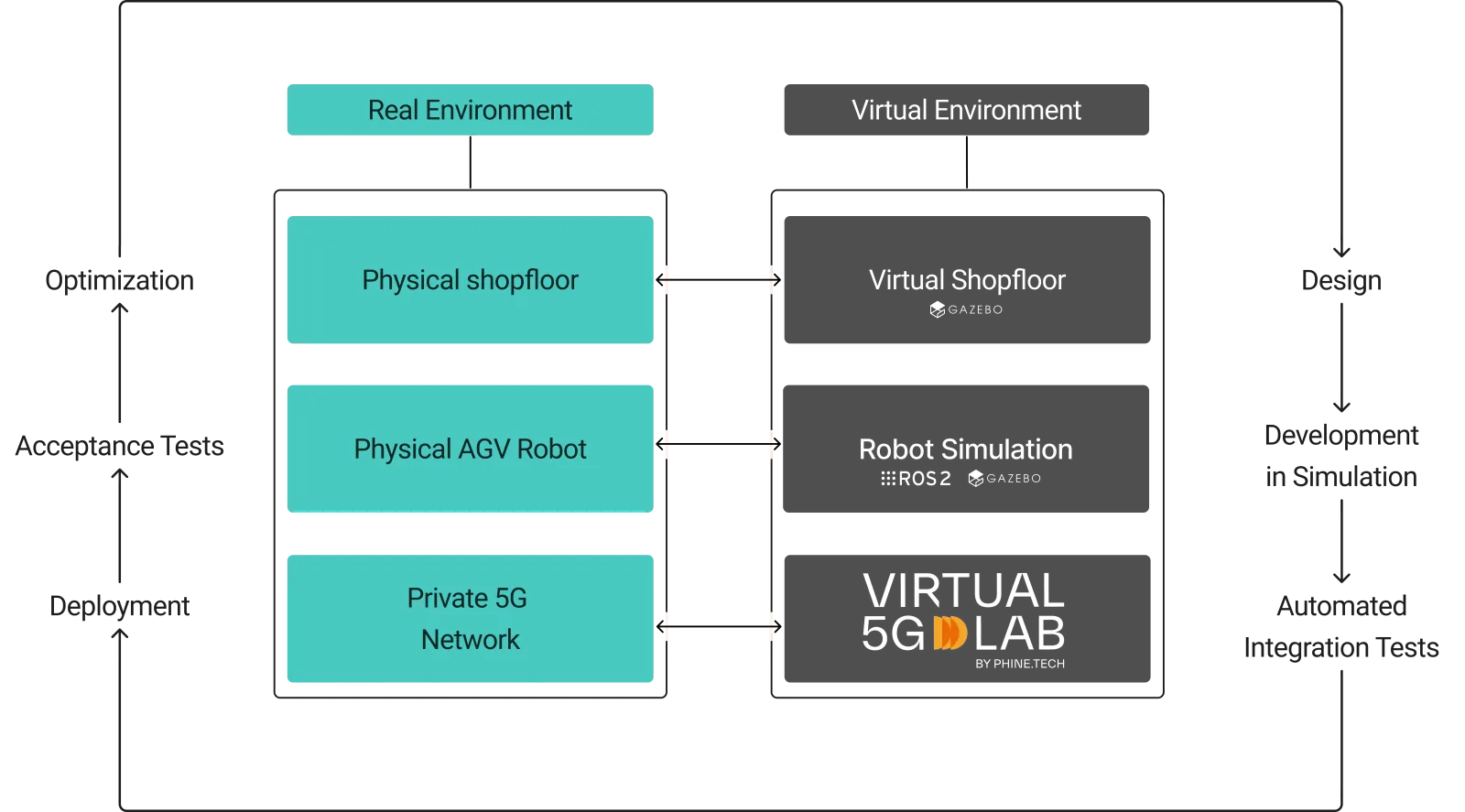
Gigabot serves as the perfect proving ground for the development methodology enabled by phine.lab. Instead of relying exclusively on the physical 5G campus network at TU Wien, the entire software stack for the robot and its remote control center is first built and validated within our virtual environment. This simulation first workflow allows for rapid prototyping and continuous automated testing. As part of this project, we are extending phine.lab to fully support advanced robotics simulations, showcasing a clear path for developing the next generation of 5G connected robots.
The Project Goals & Impact
The primary goal is to validate phine.lab as a core tool that can cut 5G application development time in half. By successfully developing the complex Gigabot use case and integrating our virtual development environment into the lab’s permanent workflow, we are establishing a new, highly efficient standard for how future 5G industrial applications are created and deployed. This lighthouse project demonstrates the immense benefits that our software brings to industrial 5G applications.
Partners

Funding Partners

GIGABOT project is funded under the research and technology development of gigabit applications as part of light- house projects Breitband Austria 2030: GigaApp financed by the Austrian Federal Ministry of Finance and by the Austrian Research Promotion Agency (FFG) under the grant agreement n. FO999917955. Breitband Austria 2030: GigaApp was initiated by the Austrian Federal Ministry of Agriculture, Regions, and Tourism.