How to Simulate Real-World 5G for Robots: A Deep Dive into RoboSim5G
By Riccardo Belletti, April 3, 2026. Also published on Medium.
1. The Context: Beyond the "Perfect" Network
In most robotics simulations, the network is treated as an invisible, perfect pipe. In the real world, 5G performance is dynamic and varies based on distance, load, and configuration.
RoboSim5G bridges this gap by integrating actual 5G software stacks directly into the Gazebo simulator. Developed by phine.tech, proudly supported by the netidee foundation, this toolset makes advanced 5G networking accessible to the robotics community, allowing developers to test their applications against realistic network behaviors without needing to be telecom experts.
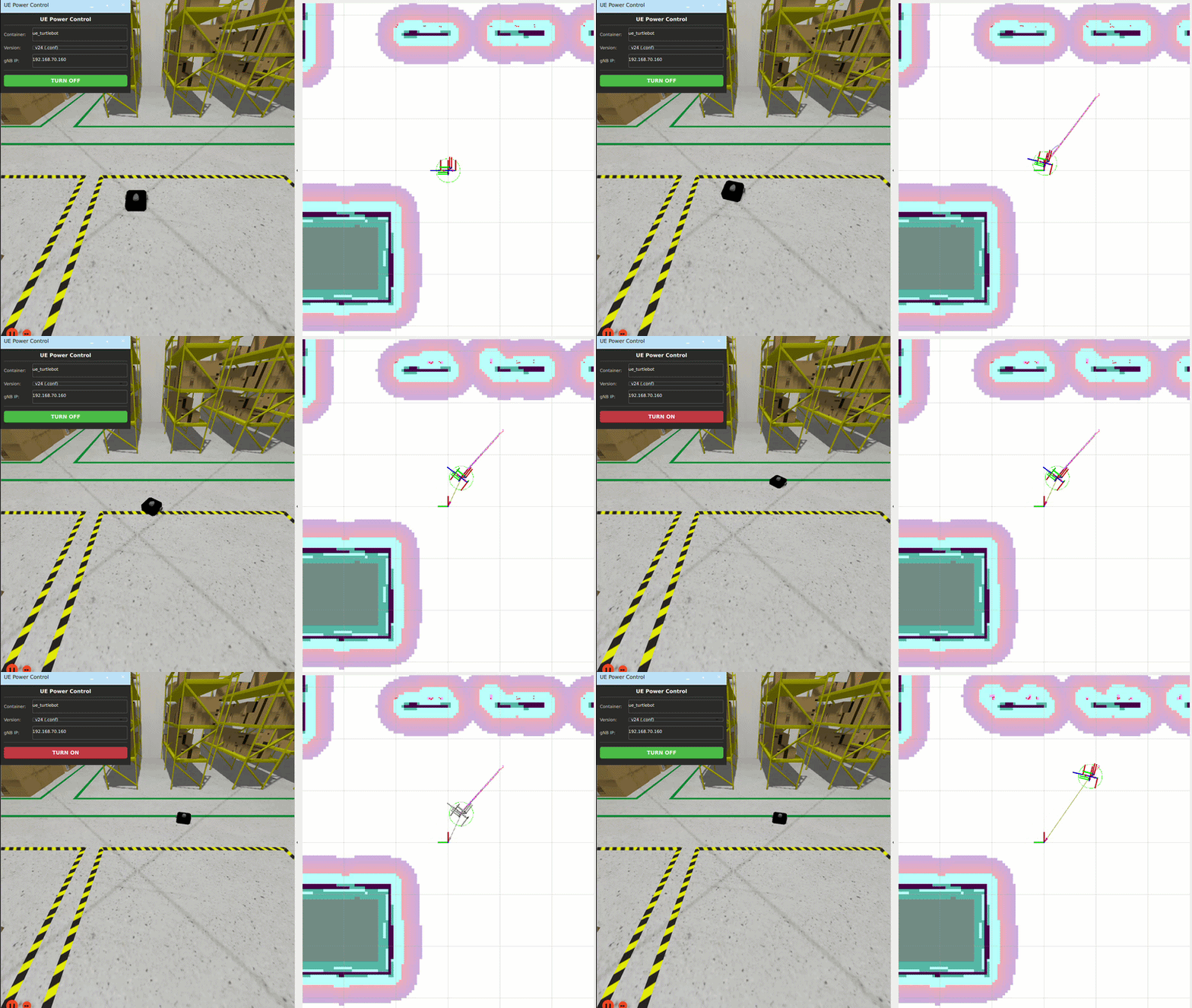
From an architectural standpoint, the system relies heavily on containerization. The simulation environment uses a dedicated "robot-UE" Docker container that continuously runs a 5G User Equipment (UE) process alongside the user's robot logic and ROS-Gazebo bridge. This container interfaces with a simulated gNodeB (gNB) and a fully containerized 5G Core Network, creating a complete end-to-end (E2E) radio and core network architecture entirely within your local machine or Docker environment.
2. The Advantage of a Real Software Stack (The API Layer)
Using a real 5G Core and RAN (Radio Access Network) stack isn't just about achieving more accurate latency. It turns the network into a programmable platform.
Because the architecture deploys actual 5G software elements, developers can interact with the network using standard APIs and Application Functions (AF). By simulating a real stack, developers can write code that queries the network for its status or requests specific behaviors using frameworks like CAMARA. This enables "Network-Aware" robotics, where a robot's navigation stack or control logic can adapt in real-time based on the live state of the 5G connection.
3. Flexibility: Support for Multiple 5G Cores
Different robotics projects have varying requirements for connectivity and management. To accommodate this, the RoboSim5G architecture is modular and supports three major 5G Core Network implementations. Developers can seamlessly swap out the core network backend while keeping their Gazebo world intact:
- Open5GS: A mature open-source implementation offering production-like stability, excellent documentation, and a user-friendly WebUI backed by MongoDB.
- free5GC: A user-friendly core network written in Go that features a comprehensive web-based interface for subscriber management, making it ideal for rapid prototyping and educational purposes.
- OAI (OpenAirInterface): A high-performance, research-focused implementation developed by EURECOM in C++, offering maximum performance and fine-grained control over network functions like network slicing.
4. QoS Enforcement: The Hybrid Architecture
Many open-source setups handle the signaling for Quality of Service (QoS) effectively but struggle with actual enforcement on the data plane.
To solve this, RoboSim5G supports a hybrid deployment architecture when using the free5GC configuration. This architectural approach leverages the user-friendly free5GC Control Plane (for functions like AMF and SMF) paired with the high-performance OAI User Plane Function (UPF) utilizing an eBPF data plane.
The result is robust QoS enforcement. When a developer sets a high-priority flow for a robot's control command, the UPF actively prioritizes that traffic over background data, such as heavy camera streams, making E2E testing incredibly realistic within the simulation environment.
5. Validating Performance: The Measurement Plugin
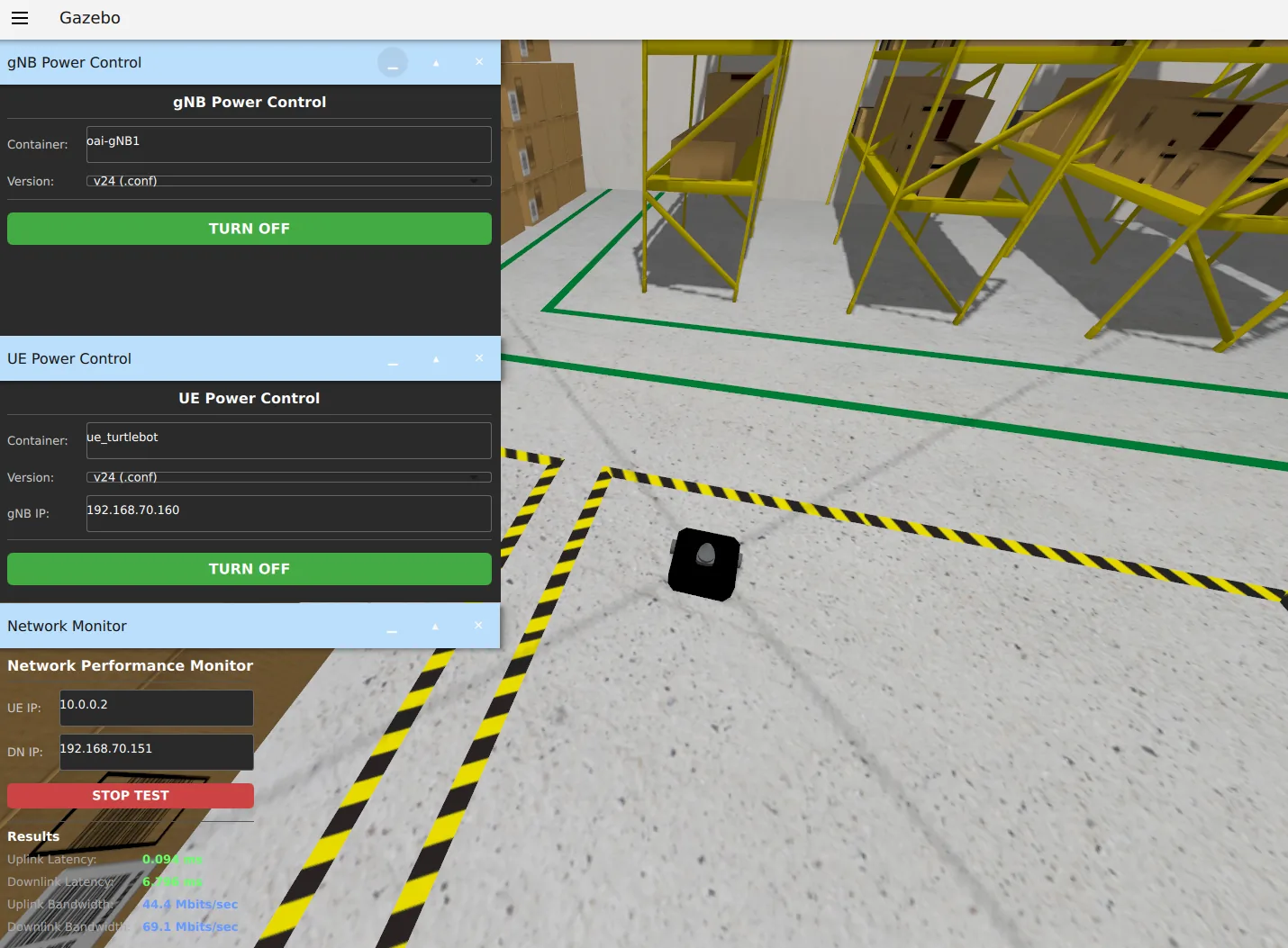
Testing a network-aware application requires immediate feedback. To close the loop, RoboSim5G features a Network Monitor GUI plugin integrated directly into the Gazebo interface.
Architecturally, this plugin executes docker exec commands to run real-time networking tools across the simulation's containers. It continuously measures downlink and uplink latency using ping, and bandwidth using an iperf3 daemon deployed on the UE container. By providing live visibility into the network state, developers can correlate a bandwidth drop or a latency spike directly with their robot's physical behavior in the Gazebo world.
6. Roadmap: Dynamic Control and "Air Quality"
The architecture is built to expand. Upcoming features focus on bringing even more dynamic control to the simulation:
- Application Function & QoD: An upcoming open-source Application Function (AF) will implement the CAMARA Quality on Demand (QoD) interface. Once integrated, users will be able to test dynamic QoD requests, allowing the robot container to request network priority on the fly based on situational needs.
- Configurable Channel Model: A future update will introduce a configurable channel model at the radio layer. This will allow users to simulate varying "Air Quality," testing how their robot handles radio interference, signal fading, or physical obstacles, providing a true stress test for the 5G connection.
7. Get Started: From Zero to 5G in Minutes
RoboSim5G is built on the philosophy that you shouldn't need a PhD in Telecommunications to build 5G-aware robots. Whether you are a researcher, a hobbyist, or an industrial developer, the barrier to entry is now officially gone. Thanks to our pre-configured Docker Compose setups, a single command brings up the Core, the gNB, and the UE.
Ready to jump in?
- Star the Project: Head over to our RoboSim5G GitHub Repository to explore the source code and support the project.
- Follow the Tutorial: We've prepared a Step-by-Step Tutorial that guides you through a complete warehouse AGV scenario. It covers everything from launching the 5G Core to establishing a connection and running your ROS 2 navigation stack.
- Join the Conversation: Have a specific use case or a feature request? Open an issue or start a discussion on GitHub. You can also reach us in our Slack channel. We're actively looking for contributors to help shape the future of "Network-Aware" robotics.